Author Archives: Gemma


Do you remember any threshold moments in your life?

By threshold moments, I mean those times when we enter a new phase, begin to see life through a different
lens, or find ourselves adapting to new circumstances. Birth and death are perhaps the biggest thresholds,
alongside the births and deaths of those close to us.
But what about the threshold moments in our working lives?

A New Chapter in My Working Life

Becoming a Director in C&C Belfast at 35 was one of mine.
At the time, I felt the satisfaction of reaching a position in
business that was beyond anything I had imagined I could
achieve. Alongside that satisfaction came the pressure of
responsibility: for the success and well-being of colleagues, and
for hitting sales targets that others relied on for their annual
bonus.

Thirty years later, I can look back on that moment as the beginning of a deeper understanding of business,
commerce and what success seemed to mean. It was success viewed through what I would now describe as an
“ego” perspective, or a “first half of life” perspective.

A Different Kind of Threshold

A “second half of life” threshold came when I began to see the truth in the saying:
“We don’t see the world as it is; we see the world as we are.”
Through my coaching training, I have come to understand this through a principle: our experiences of the
world are created from inside us.
I understand this as a principle that is always at work, whether or not we recognise it in the moment.

One of its most significant implications is the idea of “separate realities”. Each of us can interpret the same
facts and circumstances differently because our experience is being created within us.
This helps explain why society needs rules and laws to bring a sense of order, and why businesses need shared
values, processes and standard operating procedures to get things done.
It also offers a helpful way to approach our everyday conversations

Bringing Curiosity into Our Conversations

The next time a heated debate arises with a colleague or friend, pause and
remember the idea of separate realities.
Become curious about how the other person sees the situation.
What does it look like from their perspective?
That curiosity can open the door to more honest communication. When we take time to understand one
another’s experience, we are more likely to find mutual understanding and agree on the next steps.

The Threshold Within

Looking back, there is an important difference between the two threshold moments I have shared.
Becoming a Sales Director was an external threshold: a change in my role, status and responsibilities.
The second was an internal realisation: a change in how I understood my experience of life.
That internal shift has had a far more profound influence on my life and happiness than any external milestone
ever could.
What have been your life’s threshold moments, and which have changed the way you see the
world?

Jesus was fully human, so he must have had an ego. But does that mean having an ego is a good thing?

The word ego often gets a bad reputation. We tend to associate it with being egotistical, self-centred or overly focused on ourselves. But ego itself is simply our sense of identity, our understanding of who we are and how we see ourselves.

In that sense, having a strong ego and healthy self-esteem can be important. It helps us navigate life, develop confidence and understand our place in the world.

But our ego is also shaped by our upbringing, experiences and what I sometimes call our “programming”. Over time, who we think we are can become influenced by who we believe we need to be: to fit into certain roles, meet expectations or belong in the lives of others.

One of the best metaphors I’ve heard compares the ego to a violin that we play in the symphony of life.

If you were playing a violin in a symphony, you would keep it in tune. You would look after it, polish it and make sure it was in good condition. You might become so immersed in playing that you feel completely at one with the instrument.

But you are not the violin.

You are the person playing it. You are the creator of the music.


If I’m Not My Ego, Who Am I?

In spiritual thinking, the ego is sometimes described as the “false self”, in contrast with our “true self”. In other words, the identity we have built around ourselves is a part of us, but it may not be the entirety of who we are.

For me, there is something incredibly freeing about this idea.

It means I don’t have to be a slave to my thinking.

My thoughts are not who I am.

Underneath my thoughts, underneath who I think I am and underneath who I think I need to be, I believe there is something greater, wiser and more compassionate.

I’ve called this D.U.E.L. — the Divine Universal Energy of Life.

For me, it is the place, or the energy within us, from which pure love, wisdom and compassion can emerge, uncontaminated by our personal thinking.

That isn’t to say we cannot be loving, compassionate or wise while living through our ego. Of course we can. But I believe there is a deeper love, wisdom and compassion available to us when we look beyond the identity we have created for ourselves. In my own understanding, that comes not from the ego, but from the soul.

Looking Beyond Our Thinking

Knowing that I have access to this deeper part of myself, and believing that I am always connected to this Divine Universal Energy of Life, has been a major source of support for me through the worries, pressures and challenges of life.

I find it valuable in my working life too.

When I’m faced with a business problem or struggling to find an answer, sometimes the best thing I can do is stop trying to think my way through it. By letting go of the constant noise in my head, I can create space for a new idea or creative solution to emerge.

There is something reassuring about knowing that this place is always there and always accessible.

Perhaps the real challenge, then, isn’t getting rid of our ego.

Maybe it is learning to recognise it for what it is: an important part of how we navigate the world, but not necessarily the deepest expression of who we are.

We can look after the instrument. We can keep it polished and in tune.

But every now and again, it’s worth remembering:

We are not the instrument. We are the ones creating the music.

Something to think about.

It has been a while since I’ve written and shared some of my thoughts. At this stage in my life and business career, I find myself wanting to share more of the experiences I’ve had in business — particularly those that have changed the way I think about success.

For a long time, overwhelm, anxiety and stress seemed to me to be part and parcel of being successful in business and in life. My experiences over the years have challenged that belief and led me to look more deeply at how we approach not only what we do, but who we are while doing it.

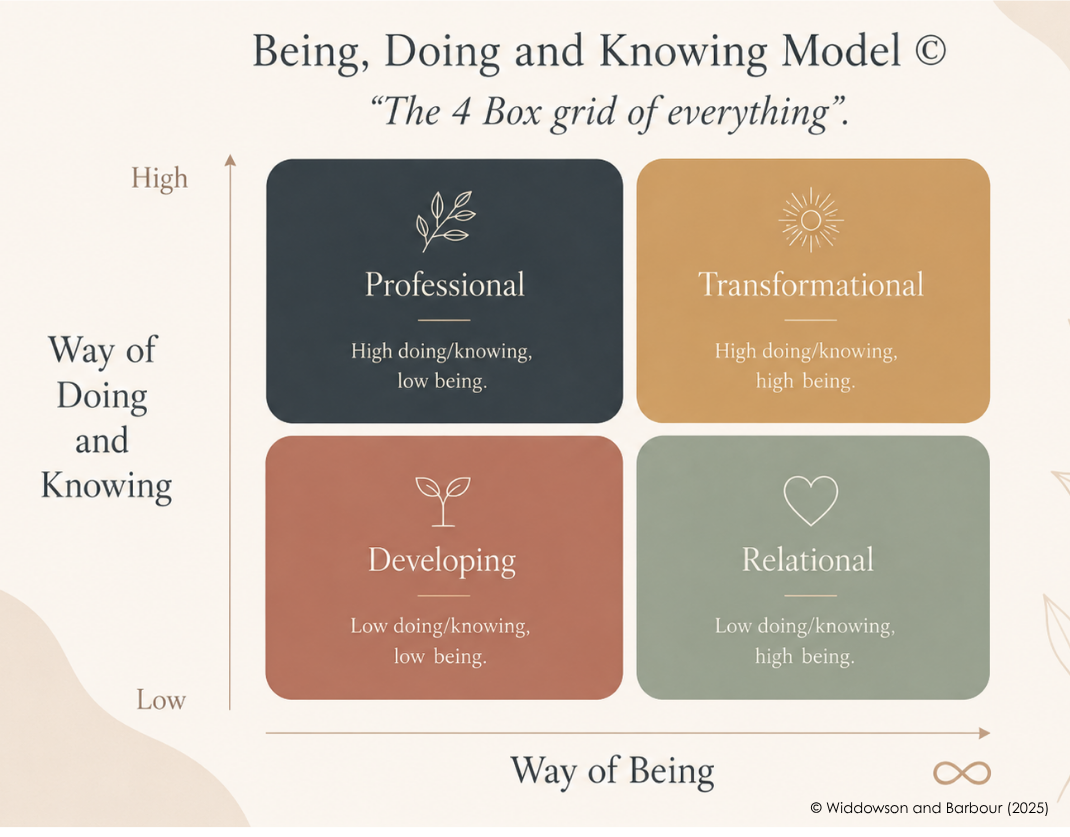
To help explore this, I’m going to “borrow and adapt” the ‘Being, Doing and Knowing’ © model of team coaching development, first put forward by Lucy Widdowson and Paul Barbour in their excellent book Building Top Performing Teams.

The “4 Box Grid of Everything”

For me, this has become what I call the “4 box grid of everything.”

Almost every aspect of business — leadership, sales, management, deal-making and more — can find a resonance in how we apply our knowing and doing, our craft if you like, alongside how we are showing up in our thinking and being our truest, authentic selves.

I also believe this 4-box grid can be applied to many aspects of our lives beyond business.


The Way of Doing and Knowing

The Doing and Knowing axis contains many of the skills and areas of knowledge we expect to find in business: commercial acumen, market and competitor knowledge, product or service expertise, interpersonal skills and communication.

It includes questioning, listening, facilitating, presenting and countless other skills. Many excellent books and articles have already been written about these areas, so this isn’t where I want to focus.

Instead, I want to explore the Way of Being.


The Way of Being

For many of us, the Way of Being is less understood because it involves looking more deeply into the nature of being human.

I believe it can hold the key to personal breakthroughs that lessen — and can even remove — some of the overwhelm, anxiety, stress, fear and burnout that happen too often in our lives and businesses.

So, what is the key to moving up the scale on the Way of Being axis?

You’ll notice I think of this as a “Low to Infinity” scale, rather than a “Low to High” scale. There is much more to explore around that idea.

But the key itself is relatively simple: be as true to your authentic self as you can be.

Like many things that are simple — rather than complex — that doesn’t necessarily mean it is easy.


Becoming Our Authentic Selves

It might seem like the most natural thing in the world to simply be ourselves. Yet, from a very young age, we begin to be shaped by the world around us.

Initially, this comes through our parents and families, followed by schools, friends and the various educational, social and sometimes religious institutions we encounter throughout our lives.

By the time we reach adulthood, our sense of who and what we really are can become buried beneath layers of who we believe others think we should be.

So why is it important to see through this programming?

The truth I have come to experience for myself is that I live in my own thought-created reality.

The circumstances of my life, or the business situations I find myself in, enter my awareness through the power of thought — thought that can often be influenced by years of programming.


So, What’s Love Got to Do With It?

Whatever our programming, whatever our upbringing, and whatever we may be thinking about the circumstances of our lives, we all tell ourselves stories that can trigger feelings and emotions.

But underneath all of this lies who and what we truly are, pure love.

The link between business performance and excellent employee well-being or great employee engagement has been well established by now. A variety of positive figures are regularly quoted to demonstrate this link, for example;

  • 13% increase in productivity (Oxford University)
  • 19% increase in overall business performance (Deloitte)
  • 21% increase in profitability (Gallup)
  • 27% increase above the average for annual net earnings per employee (Morgan Redwood)

Many organisations invest in well-being initiatives, and this is laudable, whether it’s social committees, well-being officers or in house counselling services. These can all play a role in improving employee well-being.

What is often missed though is the fundamental part, that the job role and the managing of someone within that job role, can play a large part in employee well-being and engagement. In my experience employees are more engaged in their work and have a more positive mental attitude when three fundamental questions are addressed.

  1. How well do they know what is expected of them in the role. This is beyond job descriptions, beyond their duties; it’s knowing what their boss or their colleagues and others expect from them?
  2. How well trained are they to deliver the role. From induction, through to on the job training, to bespoke competency development programmes?
  3. How well are they performance managed within that role. What level of feedback do they receive from their line manager or supervisor; how often are their KPI’s measured and reported against; how do they know that they are on track to deliver the expectations that the business has of them?

As I’ve said it’s laudable that organisations have a focus on well-being, well-being initiatives and well-being officers, but I wonder how many organisations would benefit if they put a greater focus on the fundamentals of performance management, and on the three questions posed above.

In world class employee engagement and motivation these three questions just represent the foundation. For further growth, I would look at the work of Doshi and MacGregor who reference the intrinsic motivation factors of Play, Purpose and Potential.

Play can be seen as how creative my job role might be, or it could simply be how much influence I have on decision making within my role or what autonomy I have to act on my own initiative within my role.

For Purpose, I would pose the question, does the behaviour within my employer align with my values and my inner purpose?

Potential is about answering the question, how far can I go in my career and in developing my personal capabilities within this role.

While these last three are vital for excellence in motivation, well-being, and engagement; without the foundation of excellent performance management, I believe most of the efforts in these areas will come unstuck.

What’s the performance management culture like in your organisation?

I buried a good friend last week; Brian Magennis. I don’t intend to use this piece as a testimony to the wonderful person he was or to the brilliant leader that he was, (and he was both those and much more). However, I do want to highlight the real benefits for organisations of even one influential leader in your company living a life from the place of connection to their true self, that I write about regularly in my work.

A lot of what I have written about in these blogs and on different LinkedIn posts talks about the power of connection, about the brilliant design of being human and about the wonderful outcomes that can result from bringing our authentic self into our dealings with others. In any business situation or even any situation in life, the greatest chance of a successful outcome lays in the authentic self, turning up for the conversation.

If you take the simple definition of selling that I use in a lot of my work as making a connection with the other human being and seeing how you can help, a definition that can be extended to many aspects of business where influencing and persuading communications are being carried out.  Then fostering deep connections has got to be at the heart of business relationships, fostering deep connections has got to be at the heart of great leadership.  These sorts of deep connections are not possible when the ego is doing the leading.

When we are thinking about the impact of what we do and say, and how it might reflect on us personally, we are less likely to be acting from our authentic self. We are more likely to be appealing to the intellect, and ego, of the people we are speaking with or leading, and therefore not speaking to the whole person. Not connecting from a coherent embodied place within us that is connecting with the body, mind, heart, and soul of whoever it is we are communicating with.

Building soul-to-soul connection is possible in business. It is not something to be ignored in business or relegated to the more spiritual aspects of life. It can be the foundation for transforming an organisation into one where colleagues are fully engaged in delivering the vision and goals of the group.  Where colleagues are fully invested in their work and receiving the well-being and mental health benefits that arise from the strong, meaningful connections built from being led by ‘Whole Person’ leaders.

Brian Magennis was a perfectly, imperfect example of a ‘Whole Person’ leader.  He understood that to deliver the best financial results for a business you had to lead your people from their whole person perspective, body, mind, heart, and soul.  It wasn’t just enough for the people to intellectually get what it was the business was about or what it was their roles were about.  He lived the power of deep connection to others in all his business relationships.

Miss you Brian.

As you read this, I encourage you to reflect on how you show up in your own life and work. Are you leading from a place of connection to your true self? Are you fostering deep, authentic relationships with those around you? These aren’t just ideals – they’re the foundation for creating a thriving business and a fulfilling life.

What if we allowed ourselves to lead like that? What if, in every business interaction, we showed up fully present, seeking to connect and serve rather than simply achieve? True connection transcends ego and intellect – it fosters environments where colleagues thrive, and organisations transform.

In honour of Brian, let’s strive to lead as whole, imperfect, and beautiful human beings.

Would you look for a book in a bike shop, or a bike in a book shop?  Of course not.

Yet, in business, we often search for solutions in the wrong places – like looking for the bike in a bookstore. For instance, when two colleagues clash, we frequently misidentify the root cause, assuming the problem lies in external circumstances or conflicting agendas. What if the problem was neither of those things, but was instead a difference in perspective or thinking?

Consider the parable of the four blind men describing an elephant. Each holds a different part and offers conflicting descriptions of what an elephant is like. Each account is true as that person sees it, but not an accurate description of an elephant. This illustrates how perspective shapes our understanding of problems, and perspective is always a reflection of our thinking about we are looking at. Instead of focusing solely on the issue at hand as described from one perspective, we should first examine our perceptions or our thinking about the problem.

I recently worked with a client where two directors argued over an unbudgeted investment. One believed it could boost overall margins by 10%, while the other hesitated, arguing that it was unbudgeted and potentially a risk to margin. Through discussion, it became clear that the real concern from the hesitant director was the potential impact on their bonus earnings. Once this was addressed, the opposing director was on board with the investment.
When contention arises, the key is to explore each person’s perspective and thoughts around the problem. To do this requires listening deeply, empathetically and often patiently to allows us to uncover underlying thinking around the topic.

By understanding different viewpoints and the thinking behind these, we can better identify the real issues and thus identify potential solutions. The power of deep listening, in 1-2-1s and especially in meetings, to allow us to seek solutions in the right places, is too often underestimated in business.

Finally, this quote from Helen Schucman seems relevant here;
“All miracles involve a shift in perception.”

My work with businesses often involves some form of gathering or meeting with groups of workers. The key objective is normally around a specific aspect of individual and/or team development.

The objective, and an outline of how the session will unfold, is normally agreed with either a learning and development person or the line manager/director of the team involved.

Increasingly I have noticed that, after the invite goes out, several requests for “The Agenda” are sent to me or to the organiser.  Why is this I wonder? Is the request made from some anxiety that the person may be embarrassed in not being prepared, (even though any preparation required is normally stated in the invite).  Is it exercising our in-built psychological need for a level of control? Are we sometimes so insecure that we are worried about going into a business meeting or training situation where we don’t know what is going to happen?

I’m not talking about knowing why the meeting/event is happening or indeed the objective behind the meeting. I’m referring to the need we often have to know as much as we can about who will be there, what will they do or say and what the expectations the organiser might have of me. To the extent that the agenda requirement is driven from a place of “how can I add the most value to these proceedings,” then asking for an agenda is coming from the right intention.

Like much of life, navigating our way successfully in business is about dealing with paradox, or dealing with apparently contradictory statements. On the one hand it does seem like sound business logic to have an agenda for every meeting or event we attend, on the other hand, our need for an agenda could be driven from a place of unknown fear about lack of control or appearing vulnerable and all sorts of consequential unhelpful stories that might arise, (consciously or unconsciously), from this thinking.

If the agenda request is coming from a place of “uncertainty,” and “I don’t like uncertainty,” then maybe have are think about why exactly you are asking for an agenda.

What are the invisible rules in your organisation or family?

If you observed the behaviour of you or your colleagues at work or even in your family, what would you say the “rules” are of your organisation or family?  I’m not referring to policies and procedures or even legal rules. I’m referring to the rules you might infer exist, purely from observing behaviours, or maybe in your own case, feelings and/or behaviours.

For some people, there appears to be an unwritten rule that worry precedes any significant event or meeting that you undertake. Think anything from board meeting, sales meetings, to weddings or family events. For some organisations it can appear that a rule exists that no one dare challenge the boss about any decision they might make. It can often appear that a rule exists that decisions must always be passed up the chain of command, even though written policy and even company values might indicate that empowerment and devolved decision making is to be encouraged.

What are the (unwritten) rules we live our lives by?  For example:

  • “Think of what (Insert as appropriate parents, neighbours, boss, family, clients, etc) will say.” This implies a rule of “Therefore I won’t do that, try that, or live my life the way I want to live my life.”
  •  “No pain, no gain.” Implied rule is “All work must be difficult.”
  •  “I deserve to be successful because I work hard.” Implying that “hard work’ is the only factor in achieving success.”
  • “I’m not the sort of person that is lucky in love.” (My success in finding a partner is purely down to luck and has nothing to do with me and my thinking.)
  • “I’m just like my mother, father, brother, sister.” (We use this thinking to explain why I can’t change something I want to change)

From the last couple of examples, the key to understanding unwritten or invisible rules is to recognise that it is our thinking that is creating and maintaining these rules. The longer we live with this thinking, the more familiar it becomes until it seems a hard and ‘stuck-fast’ belief in our life.

Recognise the invisible rule we create that hinder our happiness, changing the thought, changes the rule, changes your life.

Unplug, Unwind, and Unleash Your Inner Light: Coaching From The Soul – A light hearted conversation

Feeling like your thoughts are on a hamster wheel?  Longing for a deeper connection to yourself and the world around you?

Join us for a light-hearted and interactive talk series, Coaching From The Soul, where we’ll embark on a heartwarming exploration of what it means to be human.

This FREE four-week series features me and my fellow Supercoaches from the prestigious 2024 cohort of the Supercoach Academy with Michael Neill.

Here’s a taste of what awaits you:

  • Episode 1: Taming the Thought Train: Learn to manage your whirlwind of thoughts and discover the power of a focused mind.
  • Episode 2: Unearthing Your Core Self: Reconnect with your authentic self and unlock a wellspring of inner wisdom.
  • Episode 3: Peeking Through the Illusions: See beyond limiting beliefs and create a reality that truly serves you.
  • Episode 4: Living from the Inside Out: Experience life with fresh eyes and newfound joy.

Each 45-minute session promises to be a delightful journey filled with insights, laughter, and practical tools to empower you.

Mark your calendars!

  • Dates: Every Wednesday, beginning 8th May 2024
  • Time: 9:45 PT / 12:45 ET / 17:45 UK

Ready to embark on a transformative adventure?  Click the link below and subscribe to follow 

Coaching From The Soul – A Light-hearted conversation 

P.S. Spread the word! Share this exciting series with your friends and family who might also benefit from a soulful exploration.